What Happens After You File Bankruptcy (Next Steps)
By Bankruptcy for Foreclosure.com Editorial Team | Reviewed for legal context by David McNickel
After filing bankruptcy, the automatic stay is in effect and a series of required steps follows. Learn what happens next, how the court process works, and what to expect long-term.
Filing a bankruptcy petition stops foreclosure immediately through the automatic stay, but it initiates a legal process that requires ongoing participation and compliance. Understanding what happens after you file helps you navigate the process effectively and avoid the common mistakes that cause cases to fail.
Immediate Next Steps After Filing
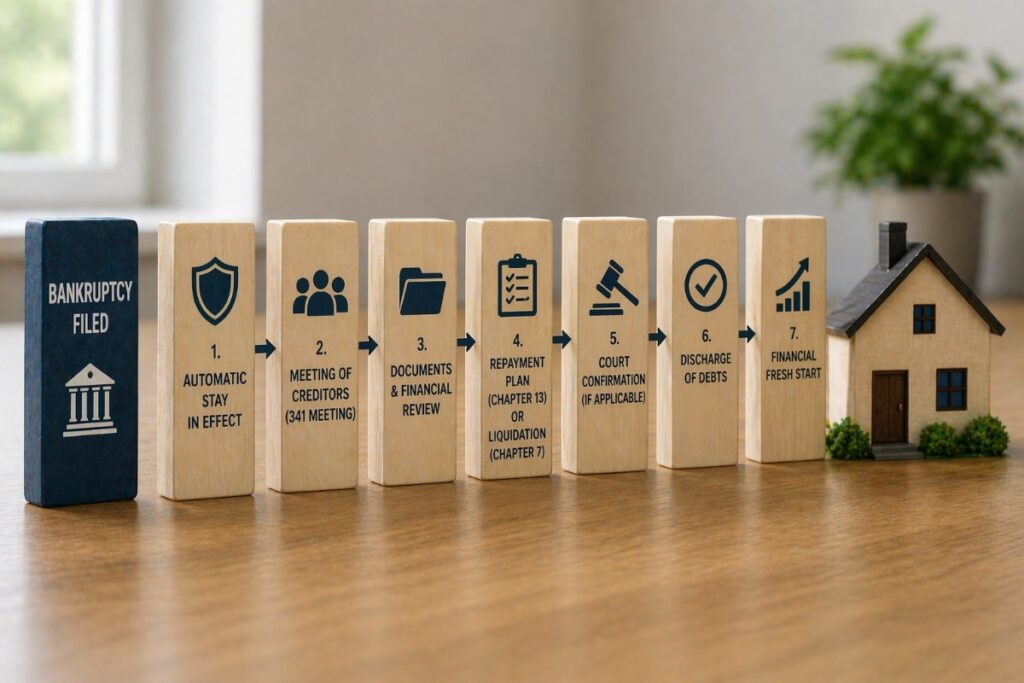
In the first few days after filing, several things happen simultaneously. The court assigns your case to a trustee and schedules a meeting of creditors, known as the 341 meeting, typically for 30 to 45 days after the filing date. You receive a case number and case scheduling notice. Your attorney notifies your mortgage lender of the filing and the automatic stay.
If you filed a skeleton petition, you must file your complete bankruptcy schedules within 14 days. Missing this deadline will result in automatic dismissal in most courts. Prioritize completing the schedules during this window.
If you are filing Chapter 13, you also have 14 days from the filing date to file your proposed repayment plan in most districts. Work with your attorney to finalize the plan during this period.
The Court Process: Key Events
Meeting of Creditors (341 Meeting)
The 341 meeting is a brief, informal proceeding at which the bankruptcy trustee questions you under oath about your financial situation and the accuracy of your schedules. It typically lasts 10 to 20 minutes. Your attorney accompanies you. Creditors have the right to attend and ask questions, though they rarely do in consumer cases.
You must bring a government-issued photo ID and your Social Security card or equivalent documentation to the 341 meeting. The trustee verifies your identity and asks questions about your assets, income, and debts.
Trustee Review in Chapter 7
In Chapter 7, the trustee evaluates your assets to determine whether any non-exempt property is available to distribute to creditors. If all assets are exempt, the trustee files a no-asset report and the case proceeds to discharge. If there are non-exempt assets, the trustee liquidates them and distributes the proceeds.
For real property, the trustee evaluates your equity above the applicable homestead exemption. If there is substantial non-exempt equity, the trustee may attempt to sell the home. If equity is within the exemption limits, the trustee abandons the property and the lender deals with it through its own foreclosure process.
Plan Confirmation in Chapter 13
In Chapter 13, a confirmation hearing is scheduled approximately 25 to 45 days after the plan is filed. The trustee and creditors review the plan and may file objections before the hearing. Your attorney responds to any objections.
If the plan meets all requirements, the court confirms it at the hearing. Once confirmed, the plan is binding on all parties. You begin making monthly plan payments to the trustee, who distributes them to creditors according to the plan.
Creditor Actions During the Case
Creditors can file proofs of claim with the court asserting what you owe them. You have the right to object to any claim you believe is incorrect. Your mortgage lender will file a proof of claim specifying the total arrears and any fees owed.
Your lender may also file a motion for relief from the automatic stay. In Chapter 7, these motions are frequently granted when the debtor is behind on payments. In Chapter 13, the motion is more likely to be denied if you have a confirmed plan and are making required payments.
Unsecured creditors can also object to your discharge or to the dischargeability of specific debts if they believe you have committed fraud or other misconduct.
Long-Term Outcomes
In Chapter 7, the discharge is typically entered three to four months after the filing date, provided no objections are filed and the trustee completes the administration. After discharge, you are legally released from personal liability for covered debts. If you surrendered the home, the lender proceeds with foreclosure. If you kept the home, you continue paying the mortgage under the original terms.
In Chapter 13, the case runs three to five years. You make monthly plan payments throughout this period. At the end, the court issues a discharge of remaining unsecured debts and the case closes. If you kept the home, your mortgage is current and continues under its original terms.
Both chapters affect your credit report: Chapter 7 for up to 10 years, Chapter 13 for up to 7 years. Rebuilding credit after bankruptcy is possible and, with consistent positive credit behavior, many people see significant credit score improvement within two to three years after a bankruptcy discharge.
Rebuilding After Filing
After bankruptcy, rebuilding financial stability requires consistent, disciplined financial behavior. Maintaining current payments on any debts that survive the bankruptcy, such as your mortgage if you kept the home, is the most important step. Opening a secured credit card and paying it in full each month helps rebuild credit history.
Creating and following a monthly budget, building an emergency fund, and avoiding taking on new debt beyond your means are all essential habits. Many bankruptcy filers find that the process of going through bankruptcy also clarified their financial situation and equipped them with better tools to manage their money going forward.
Check additional guides on filing bankruptcy to stop foreclosure.
The information on this website is provided for general informational purposes only and does not constitute legal, tax, or financial advice. Bankruptcy for Foreclosure.com is not a law firm and is not affiliated with any attorney, real estate professional, or government agency.